Become a Certified
Tarot Therapy Practitioner
Learn a practical, professional approach to reading Tarot while facilitating meaningful, therapeutic conversations that support insight, growth, and intentional change.
You don't need to be a professional Tarot reader to begin.
If you're familiar with Tarot, we'll teach you how to interpret the cards in context, guide collaborative client conversations, facilitate sessions, and use what emerges to support meaningful exploration and transformation.
Become a Tarot Therapy Practitioner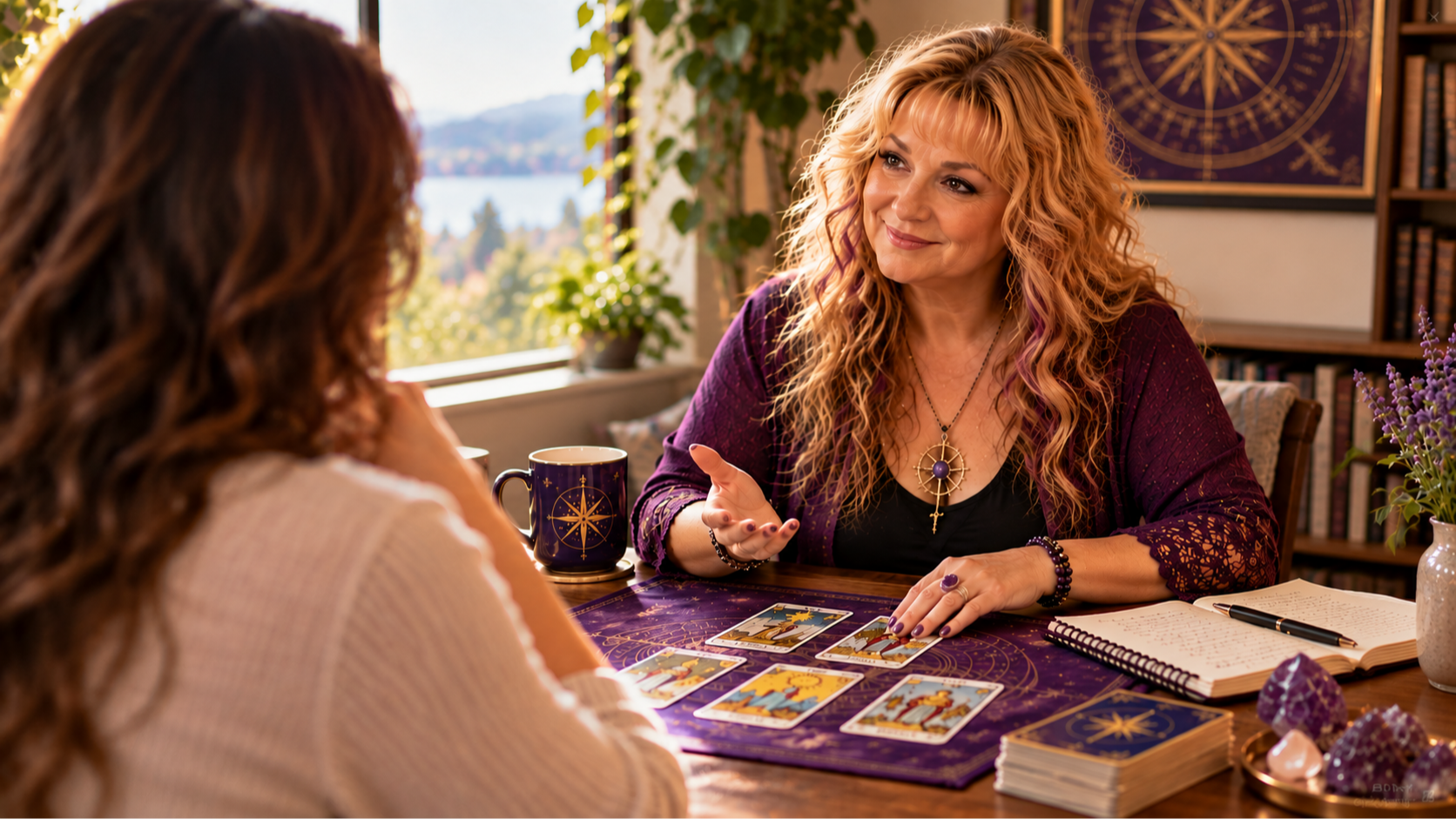
START HERE
What Is Tarot Therapy?
Tarot Therapy is more than reading cards.
It's a structured, collaborative approach that uses Tarot to open meaningful conversations, explore what is happening in a client's life, and support insight, growth, and intentional change.
But the best way to understand Tarot Therapy is to experience it.
In this introductory training from the Tarot Therapy Certification, you'll explore what Tarot Therapy is, what makes it different from other approaches to Tarot, and the principles that guide the work.
Foundations of Tarot Therapy
Watch the complete TTU 101 Foundations of Tarot Therapy training below.
This is the same Foundations training included inside the Tarot Therapy Certification.
Read the Full Video Transcript Here
TTU 101 - Foundations of Tarot Therapy
Accessible Transcript
About this transcript: This transcript reflects the spoken content of the Foundations lesson and has been lightly edited for readability and to correct obvious transcription errors. Section headings have been added to support navigation with screen readers and other assistive technology.
This transcript is provided as an accessible format for students who use screen readers, Braille displays, captions, text-based study tools, or who otherwise access course content more effectively in written form.
Welcome to Foundations of Tarot Therapy
Hi, my name is Amethyst Mahoney, and I am the founder of Tarot Therapy. And if you encountered the phrase Tarot Therapy and wondered exactly what that means, that's what we are going to explore here.
Tarot Therapy is a different way of thinking about Tarot and a different way of thinking about the role of the person sitting across the table from us. It isn't simply another system for interpreting the cards and it isn't psychotherapy, counseling, or mental health treatment, even though I was a psychologist for thirteen years. Tarot Therapy is an intentional, reflective approach to Tarot that uses the cards to support insight, meaningful conversation, self-understanding, and personal growth. And throughout this workshop, I'm going to show you what that looks like, why we've developed this approach, and how it differs from some of the ways you may already have learned to work with Tarot.
If you're exploring the Tarot Therapy Certification and trying to decide whether this approach fits the kind of practitioner you want to become, this will give you a strong sense of the philosophy behind our work. And if you're already beginning your certification, this is the foundation we'll build upon throughout your training. Either way, I want you to come away understanding not only what Tarot Therapy is, but why we believe this work matters.
Why Tarot Therapy?
So let's begin with something important. Tarot has experienced an incredible resurgence. There are thousands of books, courses, videos, podcasts, websites, communities, and teachers devoted to learning the cards. You can learn card meanings almost anywhere. In fact, I have a bunch of them on my website and a course dedicated to that. But learning Tarot and learning to work responsibly and effectively with people are not necessarily the same thing.
What does ethical Tarot practice look like? Where are the boundaries between reflection and advice? And how do we help someone explore difficult situations without becoming the authority over their life?
How do we encourage insight without creating dependency? And perhaps most importantly, how can we use Tarot in ways that genuinely help people? Those are the questions behind Tarot Therapy.
What This Workshop Explores
In this workshop, we'll explore the philosophy and purpose of Tarot Therapy, what we mean when we use the word therapy, what makes this approach different, the role and mindset of the practitioner, and the principles that guide this work.
You don't need to agree with everything I say here. In fact, I hope you'll think critically about what you hear, because one of the values you'll encounter throughout Tarot Therapy is curiosity. We're not interested in telling you exactly what to think.
We're interested in giving you better things to think about and better ways to think.
The Road Map
So here's where we're going. We'll begin by defining Tarot Therapy itself and looking at the ideas that led to its development.
We'll talk about the word therapy because that word matters. And I want to be very clear about what we're claiming when we use it and equally clear about what we're not claiming. And throughout the actual certification, we go through legalities of whether or not to use that word as well.
Then we'll look at what makes Tarot Therapy different from other approaches to Tarot. We'll explore the role of the practitioner, including something that may be a significant shift in perspective - you are not the expert on your client's life. We'll also look at the educational philosophy behind Tarot Therapy University and the professional standards that support this work. And finally, we'll look at where all of this can lead if you decide that this is the kind of Tarot practitioner you want to become. Think of this workshop as both an introduction and an invitation. You're getting the map before deciding how far you want to travel.
Learning Outcomes
By the end of our time together here, I want you to understand the philosophy and purpose behind Tarot Therapy, not simply be able to repeat a definition. You'll be able to explain what we mean by Tarot Therapy and distinguish it from psychotherapy, counseling, and other licensed forms of treatment. You'll understand some of the principles that guide ethical and reflective practice. You'll be able to identify some of the important differences between Tarot Therapy and more traditional approaches to reading Tarot.
And you'll have a much clearer picture of the role we're asking a Tarot Therapy practitioner to take.
But there's another outcome that isn't written on this slide. I want you to be able to decide, does this resonate with me? Can you imagine yourself working with people in this way? Does this reflect the kind of Tarot practitioner you already are or the kind that you aspire to become? Because learning a professional framework isn't just about acquiring new techniques. It's also about deciding what kind of work you want to do and what principles you want that work to stand on.
What Do We Mean by Therapy?
So what do we mean by therapy? This is one of the most important distinctions we'll make. For many people today, the word therapy immediately means psychotherapy, counseling, or medical practice. Those are regulated professions that require specific education, training, supervised experience, licensure, and professional oversight.
So that's not what we're claiming Tarot Therapy is. The word therapy has a much broader history and a much wider usage outside of psychology or medicine.
It comes from the Greek therapeia associated with care, attendance, service, and support and well-being.
So even today, we use the word across many different disciplines. Think of physical therapy, occupational therapy, massage therapy, art therapy, music therapy, dance therapy, sound therapy, recreational therapy, drama therapy, journal therapy.
These practices are not interchangeable. Their training, regulation methods, and scope of practice can be very different, but what they demonstrate is that human well-being can be supported through many different pathways.
Within Tarot Therapy, we're using the word to describe an intentional, reflective practice designed to support self-awareness, insight, growth, and well-being.
That definition does not expand our scope of practice. In fact, we have a whole course inside the certification on scope of practice and ethics.
And calling something therapeutic doesn't qualify us to diagnose, treat mental illness, provide psychotherapy, or practice outside our training.
In fact, understanding those limits is part of practicing Tarot Therapy responsibly.
The Evolution of Tarot
Tarot has never been one static thing. There is a whole evolution of Tarot, even in the thirty-five years that I've been practicing. Its uses and interpretations have changed dramatically across time and culture, and many people know Tarot primarily through fortune-telling and predictive practice. Others have approached the cards psychologically using their imagery and archetypes for self-understanding. Reflective approaches use Tarot to create opportunities for exploration and making meaning, and Tarot Therapy continues that evolution.
We're asking what happens when we take the reflective potential of Tarot and combine it with intentional structure, ethical practice, thoughtful communication, and professional standards. The answer isn't that every other form of Tarot becomes wrong, and that's important.
Tarot Therapy isn't an attempt to declare war on prediction or announce that everybody who's been reading differently has been doing it incorrectly. We're choosing a particular focus.
We're moving from prediction toward possibility, from what will happen toward what can I understand, explore, choose, or change?
And that's the evolution that we are interested in.
What Makes Tarot Therapeutic?
So what actually makes Tarot therapeutic? Not the cards by themselves. A deck sitting untouched on a table isn't doing anything. The therapeutic potential comes from what happens around the cards. The conversation, the reflection, the questions, and the collaboration with your client. The connection someone makes between an image on the table and something happening in their own life.
Tarot Therapy is built around several foundational principles. We emphasize reflection rather than prescription. We remain within our scope of practice. We move from prediction toward possibility.
We recognize that the client is the expert on their own life, and we treat the readings as a collaborative conversation.
And we understand that the cards begin the conversation, but they don't have to end it. This changes the practitioner's job. You don't need to sit across from another human being and produce brilliant answers on command.
You need to know how to create conditions where meaningful exploration can happen.
The cards provide symbols, people provide meanings, and conversation creates insight. That idea will show up again and again in the Tarot Therapy Certification course.
An Interdisciplinary Approach
One reason Tarot Therapy looks different for many Tarot systems is that it is intentionally interdisciplinary.
So human beings are complicated. No single discipline explains everything about how we think, make meaning, communicate, learn, change, relate to one another, or understand ourselves, others, and the world around us. Tarot Therapy draws from multiple areas of knowledge.
Psychology can help us understand aspects of human thought and behavior. Counseling skills can teach us about communication and presence without pretending that a Tarot practitioner is a counselor.
Ethics helps us think about responsibility. Symbolism and mythology help us understand the images we're working with. Numerology, Qabalah, and other disciplines can inform the meanings that you start listing as possibilities for the cards.
Education and adult learning help us understand how people encounter and integrate new ideas. Coaching offers useful perspectives on questions, goals, and action.
Narrative approaches remind us that human beings understand their lives partly through stories, and Tarot itself gives us an extraordinarily rich symbolic language through which those conversations can occur.
The goal isn't to turn Tarot practitioners into amateur psychologists, counselors, philosophers, or anything else. It's to become better informed Tarot practitioners specifically. Because the more thoughtfully we understand the human being sitting across from us, the more responsibly we can work with them.
Tarot Therapy as Professional Practice
So this is where Tarot Therapy becomes more than a method for conducting a reading. It's also a statement about professional practice. If someone trusts us with their fears, relationships, hopes, grief, uncertainty, dreams, major decisions, and deeply personal stories, that trust deserves to be taken seriously.
So we value ethical responsibility, thoughtful questions, psychological insight, reflective practice, lifelong learning, and respect for client autonomy.
Professionalism doesn't diminish intuition. It doesn't make Tarot sterile. And it certainly doesn't require you to abandon your spirituality, your intuition, or your personal reading style. Professionalism gives those things a responsible container.
And it asks us to consider not only can I do this, but should I do this? Am I qualified to? What effect might this have on the person sitting across from me? And what responsibility comes with the trust they're placing in me?
These are the questions that we attempt to address throughout the Tarot Therapy Certification. We're not trying to make Tarot practitioners more impressive. We're trying to make the work more thoughtful, ethical, meaningful, and useful.
A Working Definition of Tarot Therapy
So what is Tarot Therapy? We can take everything we've discussed and put it into a working definition. Tarot Therapy is the intentional use of Tarot as a reflective tool to facilitate insight, self-understanding, meaningful conversation, and personal growth. Now, what isn't in that definition, it doesn't require you to believe that Tarot predicts a fixed future.
It doesn't require supernatural powers or being psychic. It doesn't require you to surrender your existing spiritual beliefs, and it doesn't require the practitioner to possess secret knowledge that the client doesn't have.
Instead, Tarot gives us something to work with: images, symbols, archetypes, stories, and patterns.
The cards can help us approach familiar experiences from unfamiliar angles.
And sometimes that's enough to notice something we hadn't noticed before and to help our clients receive an insight or breakthrough they might not have otherwise come to.
Sometimes new perspectives change the entire conversation.
Tarot Therapy isn't about telling the future. It's about understanding the present so we can choose our path forward and create the future that we desire.
The Purpose of Tarot Therapy
The purpose of Tarot Therapy is actually pretty simple. We want to help our clients gain clarity, deeper self-understanding, and make more empowered choices through meaningful conversations and symbolic insight.
That means there are several things Tarot Therapy is deliberately not doing. We're not primarily trying to predict future events that are fixed. We're not trying to demonstrate that we know more or have supernatural powers. We're not telling people what they have to do.
And we're not trying to fix or save anyone. And that last one matters.
The urge to rescue can feel compassionate, but rescuing someone often requires us to assume that we know what their life should look like. Tarot Therapy starts somewhere else. We trust that people possess wisdom, experience, values, strengths, and the capacity to make choices as well as their own decisions. Our job is to help create a space where they can access those things more clearly. We don't walk the path for them. We help them to see the path.
How Tarot Therapy Is Learned
This philosophy doesn't only influence how we work with clients, it influences how Tarot Therapy is taught. We don't believe professional development happens simply because someone watches enough videos or memorizes enough information.
Knowledge matters, and it's a cornerstone of our teaching. But knowledge alone doesn't necessarily change how someone practices. So throughout Tarot Therapy training and in the Certification course, we engage deeply with ideas.
We practice thoughtful questions, and we develop practical skills. We continually examine how what we're learning affects the way we actually work with clients.
You may encounter an idea that confirms something you've believed for years.
You may encounter another that makes you uncomfortable or makes you question what you thought was true.
And you may sometimes disagree with me. All of that is good. I would much rather develop practitioners who can think critically about their work than practitioners who simply memorize what their instructor says.
The goal isn't information alone. It's integration. Knowledge becomes wisdom when it changes how we show up in our sessions with clients.
From Knowledge to Transformation
So our learning process in Tarot Therapy University begins with knowledge. You encounter new ideas, concepts, frameworks, and perspectives. Then comes reflection. What does this mean?
How does it relate to what I already believe? And where does it challenge me? Reflection can lead to insight, that moment when something suddenly connects in a different way. But insight alone isn't enough.
Next comes integration. So we connect what we've learned to our values, experiences, and existing practice. Then comes practice itself. We apply it in conversations, readings, exercises, and eventually real-world situations.
And over time, that process can create transformation.
Not because a course magically transforms someone and not because the certificate does. Transformation happens because repeated learning, reflection, integration, and practicing the actual method gradually change the way we think and the way we work with clients.
That's why becoming a Tarot Therapy practitioner is a process. There isn't one technique that suddenly makes you a practitioner. You become one through the work.
The Role of the Practitioner
So what is your role in all of this? First, you're not an expert on your client's life. They are the expert. You may know more about Tarot, and you may know more about symbolism. You may have training in facilitation, communication, ethics, questioning, and reflective practice, or you may not have had any of that yet, but they have something you will never have, their lived experience. So your role as a Tarot Therapy practitioner is to facilitate insight that requires presence, curiosity, clarity, boundaries, and empowerment.
And sometimes you'll interpret the card, sometimes you'll ask a question, sometimes you'll notice a pattern, but sometimes the most useful thing you can say is, that's interesting, tell me more.
Professional confidence doesn't require pretending that you always know the answer. It means knowing how to remain present, curious, and skillful even when you don't. The best practitioners don't have all the answers, but they do know how to help others find their own.
Ethics and Scope of Practice
Now, none of what we've discussed works without ethics, and when people bring us vulnerable parts of their lives, we have responsibilities, and we need to consider harm, confidentiality, informed choice, boundaries, competence, respect, and inclusion. And perhaps one of the most important professional skills of all is knowing when something is outside our role.
When do you need to refer out? Scope of practice isn't simply a frightening list of things you're forbidden to do. It helps answer practical questions like what's my job? What isn't my job? What am I qualified to help with? And what should I do when I'm not sure? When should I refer someone to another type of professional?
Those questions deserve far more attention than we can give them here, which is why ethics and scope of practice receive dedicated attention within the full Tarot Therapy Certification course. For now, I want you to remember this, ethics aren't restrictions on meaningful work. They're what make meaningful work safer and more trustworthy. And honestly, I think discussing ethics is fun because it's really about learning people's values and deciding what is the most ethical thing to do for their specific situation.
The Journey Ahead
So for the journey ahead, if everything we've discussed so far resonates with you, the next question is, how do you actually learn to do this?
You don't master Tarot Therapy in one workshop - you shouldn't. Professional competence develops gradually, and throughout the Tarot Therapy Certification, we take the principles you've encountered here and turn them into practical skills.
We don't just tell you what we're doing, we show you how to do it in session with clients. So you'll learn how to ask thoughtful questions, how to work with symbolism without forcing meaning onto a client, how to listen and communicate more effectively, how to recognize and maintain professional boundaries, how to approach difficult situations ethically, how to facilitate meaningful therapeutic conversations.
And you'll have opportunities to reflect, practice, receive feedback, and continue developing your own professional identity, not only through the core curriculum, but also through our Continuing Education Center.
You don't have to abandon the Tarot reader you already are. We're not trying to manufacture identical practitioners. Think of Tarot Therapy as providing the professional framework within which your own experience, personality, spirituality, intuition, and reading style can continue to develop.
If you're already enrolled in the Certification, this is the journey you're beginning. And if you're still considering whether Tarot Therapy University is right for you, I hope you now have a much clearer picture of what we're building and why. The question isn't whether you want another Tarot course. The question is, is this the kind of practitioner you want to become?
Core Ideas and Closing
So everything we've explored comes back to a few core ideas. Understand the philosophy behind the work, learn the language of ethical reflective practice, embrace the standards and responsibilities that come with working with other people, commit to growth, learning, and professional development, and become part of a larger effort to raise the standard of what thoughtful Tarot practice can look like. You don't need to know everything today, and you don't need to have every answer.
In fact, one of the central principles of Tarot Therapy is learning to become more comfortable without having all the answers. Because our work isn't to tell people who they are or what they should do. Our work is to help them discover it for themselves.
If you're continuing into the Tarot Therapy Certification, everything you learn from here will build upon this foundation.
So I hope this has given you enough of the actual philosophy and substance of Tarot Therapy to make an informed decision for yourself, because ultimately that's what this work is about - not telling people what they should do, but giving them the information, insight, and space to choose their course intentionally.
And whatever you choose to do next, I hope you'll carry some of these ideas into the way you work with Tarot and with the people who trust you enough to sit across the table from you.
YOU'RE FAMILIAR WITH TAROT. BUT ARE YOU READY TO READ FOR SOMEONE ELSE?
You may know some card meanings, have a favorite deck, pull cards for yourself, or have even started reading for other people.
And you may still wonder whether you know enough.
Because reading Tarot professionally isn't about memorizing every possible meaning of every card.
It's knowing what to do when:
- Several meanings could fit the same card.
- Your client sees something completely different than you do.
- A card doesn't seem to make sense.
- A client suddenly realizes the reading is connected to something much bigger.
- The conversation moves beyond the cards.
- You uncover an important insight...and then don't know what to do with it.
Being familiar with Tarot is enough to begin.
Tarot Therapy teaches you a practical way to interpret the cards in context, work collaboratively with the person sitting across from you, and facilitate a professional session even when you don't have every answer.
You don't need to know everything about Tarot.
You don't have to have every symbol, numerological association, astrological correspondence, Qabalistic association, or Myers-Briggs correlation memorized. It's great if you do, but Tarot Therapy teaches you what to do with that information.
You need to know how to work with what shows up.
WHAT IS TAROT THERAPY?
Tarot Therapy is a structured, collaborative approach to using Tarot for insight, exploration, growth, and meaningful change.
The cards give us something to work with: images, symbols, stories, patterns, and possibilities. But the cards are only part of the process.
The practitioner brings knowledge of Tarot and the process.
The client brings knowledge of their own life.
Neither replaces the other.
Rather than positioning the practitioner as the person with all the answers, Tarot Therapy creates a conversation. We explore what the client notices, what the cards may suggest, what connections emerge, and what those discoveries might mean in the context of the client's actual life.
The cards don't dictate what someone should think, feel, or do.
They give us somewhere to begin.
And from there, we have a process for exploring what emerges.
TAROT THERAPY IS SOMETHING YOU DO WITH THE CLIENT, NOT TO THE CLIENT.
You aren't performing a reading at someone while they wait for you to reveal the answers.
You're working together to create insight, explore possibilities, recognize patterns, and discover what may be worth looking at more deeply.
The client remains the expert on their own life.
Tarot Therapy gives you the tools and professional framework to help facilitate the process.
Tarot Therapy is not psychotherapy or mental-health treatment, and Tarot Therapy Certification does not qualify practitioners to diagnose or treat mental-health conditions or provide services outside their professional scope.
YOU DON'T NEED TO BE AN EXPERT TAROT READER
You don't need to arrive knowing every card.
You don't need to have memorized hundreds of keywords, symbols, correspondences, and reversed meanings.
And you don't need years of experience reading professionally.
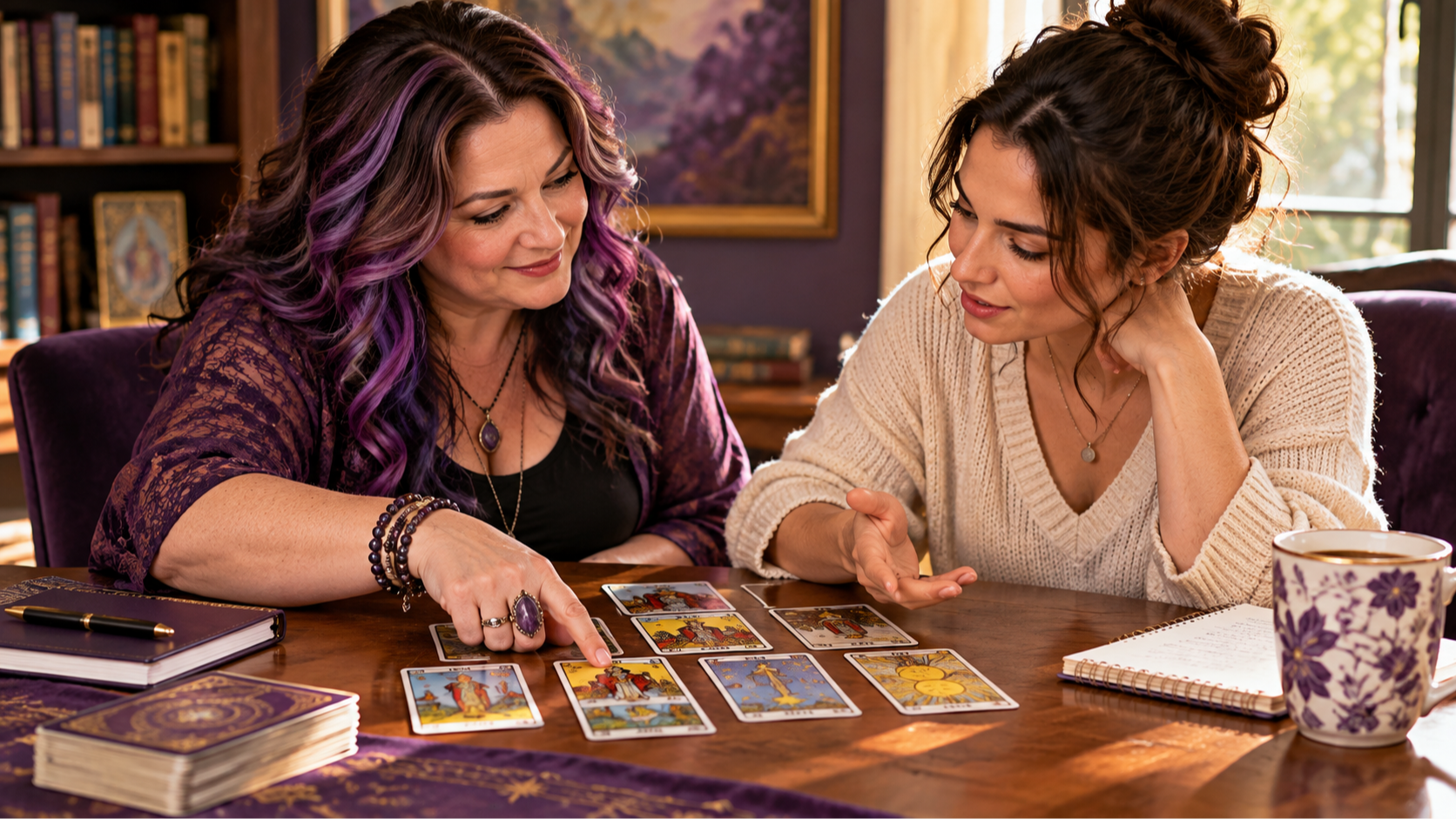
You should be familiar with Tarot. We'll teach you a practical process for actually reading it.
You'll learn how to work with:
- What's actually happening in the card
- Imagery and symbolism
- Commonly recognized card meanings
- Context
- The client's own observations and associations
- The question or issue being explored
The goal isn't to find THE Correct Meaning™ hidden somewhere in a guidebook.
It's to determine what this card means here, in this reading, with this person.
COMPLETELY NEW TO TAROT?
That's okay, too. If you're still learning the cards themselves, you can start with Hello, Tarot before beginning the Certification.
Hello, Tarot! teaches you the commonly recognized meanings of the cards and gives you the foundation you'll need before moving into professional client work.
BEFORE YOU BEGIN
Then you'll learn how we read and interpret the cards with the Amethyst Tarot Method.
This course teaches a practical, repeatable five-step process for moving from everything a card could mean to what it means in a specific reading.
If you're familiar with Tarot but still find yourself thinking, “Okay, I know what this card can mean...but how do I know what it means here?” start there.
Both of these foundational courses are provided when you sign up for the Tarot Therapy Certification.
A COMPLETE PROCESS - NOT JUST A COLLECTION OF TECHNIQUES
One of the hardest parts of learning to work professionally with Tarot isn't finding more techniques.
It's figuring out how everything fits together when there's an actual person sitting across from you.
That's what the Tarot Therapy Certification is designed to teach you.
We'll guide you through the complete process of working with a client, from interpreting the cards and finding a focus to facilitating the conversation, exploring what emerges, and bringing the session toward meaningful integration.
YOU'LL LEARN HOW TO:
- Interpret Tarot cards in context.
- Create a broad picture of what's happening across a client's life.
- Identify a meaningful focus for deeper exploration.
- Structure and facilitate a complete Tarot Therapy session.
- Have collaborative, client-centered therapeutic conversations.
- Recognize patterns, connections, and possibilities as they emerge.
- Offer therapeutic practices when they may be useful.
- Help clients move from insight toward integration or intentional action.
- Recognize when something falls outside your scope.
- Work within clear professional and ethical boundaries.
And you won't be left trying to figure out how all of those pieces fit together on your own.
This is a system for working with clients - not a pile of Tarot techniques you have to figure out how to assemble yourself.
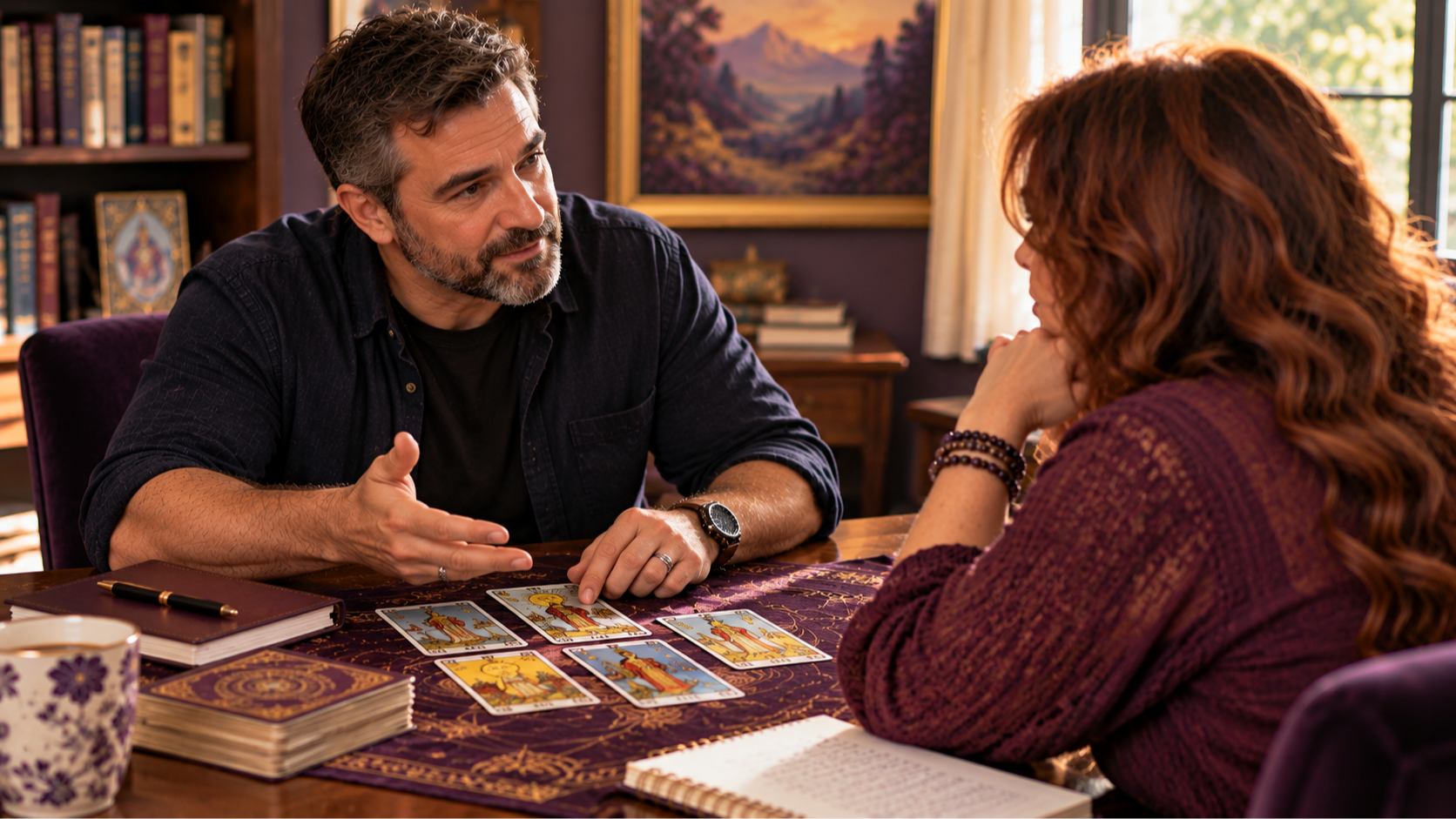
TAKE THE PRESSURE OFF BOTH SIDES OF THE TABLE
You don't have to perform.
Your client doesn't have to arrive with the perfect problem.
A Tarot Therapy practitioner doesn't have to walk into every session with a mental list of fascinating topics, brilliant questions, or profound insights.
Your job isn't to entertain the client, perform psychic feats, or manufacture something meaningful enough to justify the session.
The process gives you something to work with.
The cards create material for exploration. The structure helps you know what to do with it. And the conversation develops from what actually emerges.
Your client gets that same relief.
They don't have to arrive knowing exactly what they want to talk about. Sometimes they have a specific problem. Sometimes they only know the general area. And sometimes the most accurate answer to “What would you like to work on today?” is:
“I don't know.”
That's enough.
THIS ISN'T JUST A GENERAL READING
When your client doesn't know what they want to explore, you don't have to default to:
“Okay, let's just see what the cards want you to know!”
There's nothing wrong with a General Reading. But it's broad by design.
Tarot Therapy gives you ways to begin broadly and develop a meaningful focus from what emerges.
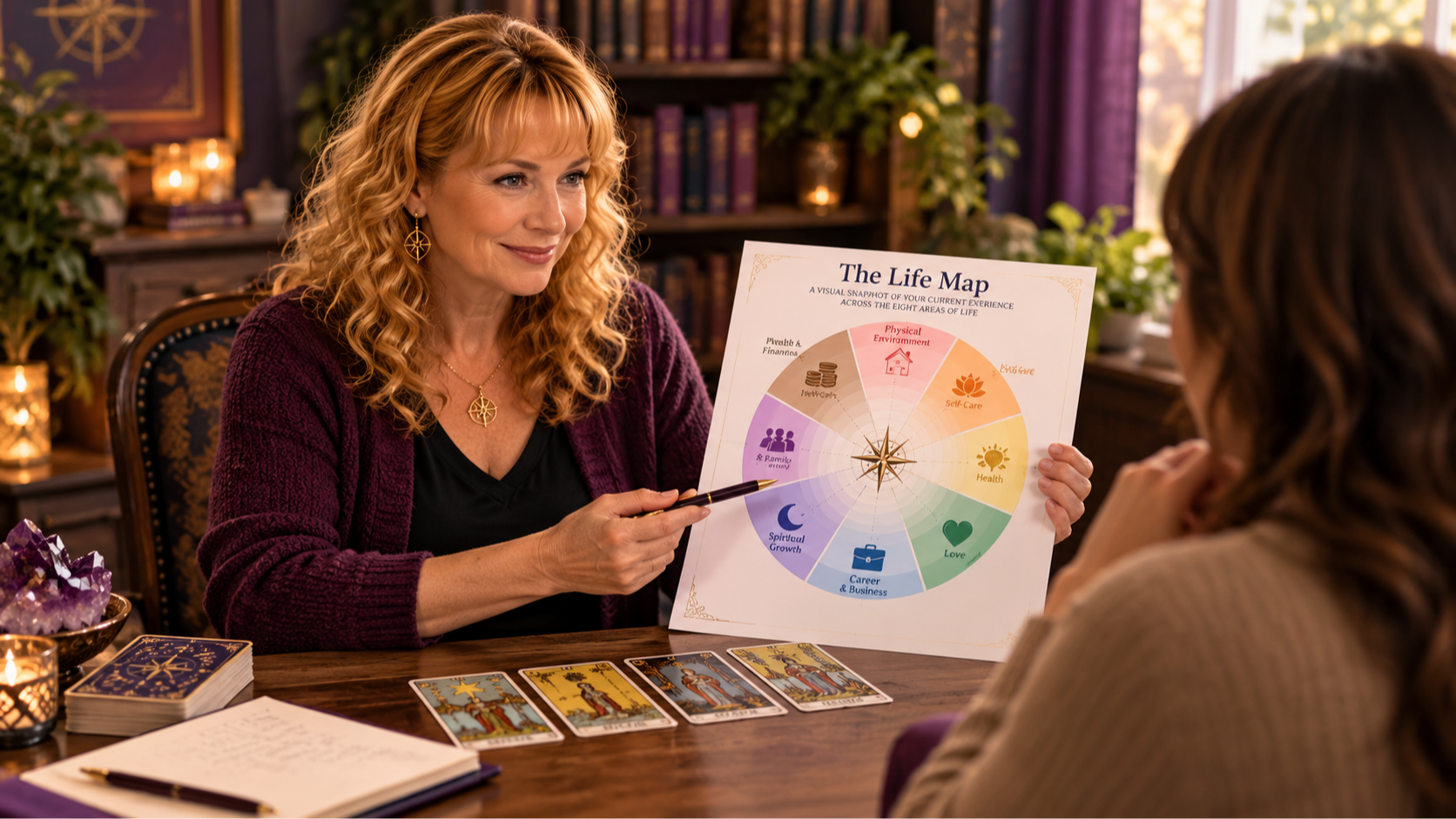
A Life Map can identify an area worth exploring.
A card can give the conversation an entry point.
A client's reaction can reveal what matters.
A small observation can become the thread worth following.
The client doesn't need to bring the topic.
The practitioner doesn't need to invent the topic.
Together, you discover what deserves attention.
That's the balance Tarot Therapy gives you:
Enough structure that you don't have to wonder what to do next.
Enough flexibility to follow what actually matters.
Tarot Therapy is also designed to support the client's own insight and decision-making rather than creating dependence on the cards, repeated readings, or the practitioner.
The goal isn't to become someone your client needs in order to navigate their life. It's to help them become better able to navigate it themselves.
What’s Included In the Tarot Therapy Certification
A complete professional training path for learning to work with Tarot, conversations, and clients -
from interpreting the cards through facilitating complete Tarot Therapy sessions.
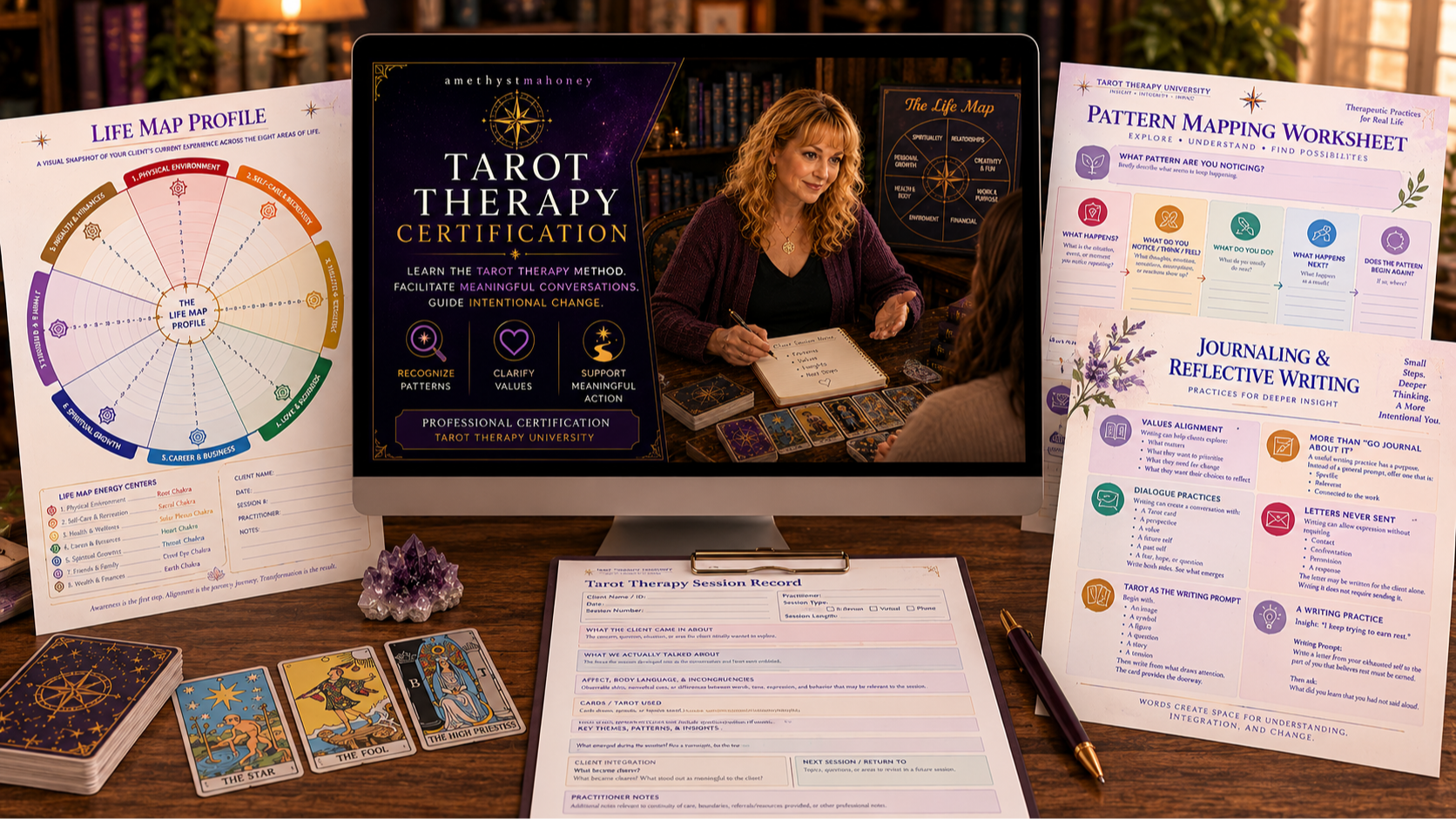
READ TAROT THERAPEUTICALLY
Learn how to move beyond memorized definitions and explore what a card means in this reading, with this client, around this particular question or situation.
You'll learn about:
Card Imagery & Symbolism • Commonly Recognized Meanings • Context • Client Observations • Reading Reversals • Choosing Among Multiple Possible Meanings
CREATE A MAP & FIND THE FOCUS
Learn to use the Life Map to create a broad snapshot of what's happening across a client's life, identify areas worth exploring, and move from “I don't know what I want to talk about” toward a meaningful focus.
You'll learn about:
The Eight Life Areas • Client Ratings • Life Map Intake • Tarot Layer • Significators • Reading the Completed Map • Moving From Area to Focus • Periodic Reviews
FACILITATE COMPLETE TAROT THERAPY SESSIONS
Learn how to move from opening the conversation through exploring the cards, following what has energy, integrating what emerges, and bringing the session to a meaningful close.
You'll learn about:
Opening the Session • Finding an Entry Point • The Three-Card Tarot Therapy Framework • Following What Has Energy • Staying With One Card • Integration • Closing the Session
HAVE THERAPEUTIC CONVERSATIONS & SUPPORT WHAT EMERGES
Learn how to listen, reflect, ask useful questions, contribute your own knowledge appropriately, and offer practical therapeutic practices when insight leads somewhere worth exploring.
You'll learn about:
Listening • Reflection • Exploration • Contributing Without Taking Over • Patterns • Values • Reframing • Journaling • Thought Awareness • Intentional Action • Symbolic Integration
PRACTICE PROFESSIONALLY & ETHICALLY
Learn how to work within a clear professional role, maintain appropriate boundaries, recognize when something falls outside your scope, document your work, and support client autonomy rather than dependence.
You'll learn about:
Scope of Practice • Professional Boundaries • Referral • Ethical Decision-Making • Client Autonomy • Case Files • Professional Record Keeping • Practitioner Responsibility
Then I'd close the overview with something like:
And you won't just learn about Tarot Therapy. You'll practice putting it together.
Throughout the Certification, you'll complete exercises, Life Map work, practice sessions, quizzes, and a final Practicum designed to help you integrate what you've learned into the way you actually work with clients.
Become a Certified Tarot Therapy PractitionerYOUR TAROT THERAPY CERTIFICATION CURRICULUM
The Tarot Therapy Certification Core Curriculum consists of these trainings:
TTU 101 - Foundations of Tarot Therapy
The foundation, philosophy, and principles behind the work.
TTU 111 - Interpreting the Cards
A practical approach to understanding what a Tarot card means in context.
TTU 201 - The Life Map in Tarot Therapy
Learn the Life Map framework and how it creates a broader picture of a client's experience.
TTU 202 - The Life Map Intake Session
Learn how to facilitate the complete Life Map Intake process.
TTU 105 - The Therapeutic Tarot Session
Learn how to structure and facilitate a complete Tarot Therapy session from opening through integration and closing.
TTU 103 - Therapeutic Tarot Conversations
Learn how to facilitate collaborative, client-centered conversations around the cards.
TTU 106 - Therapeutic Practices in Tarot Therapy
Build a practical toolkit for helping clients explore insight and possibilities more deeply.
TTU 104 - Scope of Practice and Ethics
Learn the professional boundaries, ethical responsibilities, referral considerations, and record-keeping practices of Tarot Therapy.
Approximately 13 hours of recorded instruction across 14 trainings/videos, plus exercises, application, practice, quizzes, and the final Certification Practicum.
WHAT YOU'LL LEARN TO DO WITH IT
And that's where we can give them a concise tour through the actual practitioner experience:
Create the Map.
Use the Life Map to begin broadly, understand the client's current landscape, notice patterns and connections, and identify areas that may deserve deeper exploration.
Facilitate the Session.
Know how to open the conversation, find a focus, work with the cards, follow what has energy without losing the session, integrate what emerges, and close deliberately.
Have the Conversation.
Learn to listen, reflect, explore, contribute, and check in - without turning the session into either a rigid script or a practitioner monologue.
Support What Emerges.
Build a therapeutic-practice toolkit for working with values, patterns, different internal perspectives, writing and reflection, thoughts, reframing, experiments, intentional action, and symbolic integration.
Practice Professionally.
Understand scope, boundaries, referral, ethical decision-making, professional responsibility, and record keeping - while supporting the client's autonomy rather than creating dependence on you or the cards.
You aren't learning a collection of disconnected techniques. You're learning how to move through the work - from the first conversation to meaningful exploration, integration, and professional follow-through.
YOU WON'T JUST WATCH VIDEOS
Certification isn't based on how long you can sit in front of a screen.
Watching the trainings gives you the knowledge and framework. But becoming a Tarot Therapy Practitioner means learning how to use what you've learned.
Throughout the Certification, you'll put the material into practice through:
- Exercises and reflection
- Life Map work
- Therapeutic-practice exercises
- Course Completion Quizzes
- Practice with the Tarot Therapy process
- A complete Tarot Therapy practice session
- The final Certification Practicum
You'll have opportunities to work with the tools, experience the processes for yourself, practice using them with others, and reflect on what you're learning along the way.
Then, in the final Practicum, you'll bring the pieces together.
You don't have to demonstrate perfection.
You do need to demonstrate that you understand the Tarot Therapy process and can begin applying it thoughtfully, ethically, and responsibly.
Submissions are personally reviewed within about two weeks.
If there are any issues, we'll let you know.
We are here to support you in your completion of the work, give feedback, answer questions, and help you to become a successful Certified Tarot Therapy Practitioner.
Learn it. Practice it. Put it together.
That's how you earn your Tarot Therapy Practitioner Certification.
YOUR FIRST YEAR OF CONTINUING EDUCATION IS INCLUDED
Certification isn't intended to be the end of your education.
When you earn your Tarot Therapy Practitioner Certification, you'll also receive one year of access to the Tarot Therapy Continuing Education Center.
The CE Center gives you opportunities to continue developing your skills through additional Tarot Therapy trainings, explore practices and topics in greater depth, and learn how to build and grow a thriving business.
Continuing Education also provides a way for Certified Tarot Therapy Practitioners to maintain active standing by completing ongoing education requirements.
Your first year of access is included with your Certification.
WHO THIS IS FOR
The Tarot Therapy Certification may be for you if:
- You're familiar with Tarot but don't yet feel confident working with clients professionally.
- You already read Tarot professionally but want a more structured, repeatable process.
- You want to move beyond interpreting cards into deeper, more meaningful client conversations.
- You're interested in using Tarot for insight, exploration, growth, and meaningful change - not prediction alone.
- You're a Tarot reader, coach, healer, spiritual practitioner, or helping professional interested in integrating Tarot appropriately into your work.
- You want to work with your clients rather than positioning yourself as the authority on their lives.
- You want enough structure to know what to do next without following a rigid script.
- You want clear professional boundaries, scope, and ethics around your Tarot Therapy work.
You don't need to know everything about Tarot before you begin.
But, you should be familiar with the cards and ready to learn how to use them in a practical, collaborative process with clients.
COMPLETELY NEW TO TAROT?
Start with Hello, Tarot! to learn the cards and build your foundation. We provide this beginner course when you sign up.
WHO THIS IS NOT FOR
Tarot Therapy probably isn't the right fit if you're looking for training that:
- Focuses primarily on fortune-telling or making definitive predictions about the future.
- Gives you a rigid script for exactly what every card means and exactly what you should say.
- Positions the practitioner as the person who knows what's true for the client.
- Encourages clients to depend on repeated readings, the cards, or the practitioner to make decisions.
- Qualifies you to diagnose or treat mental-health conditions or provide psychotherapy.
Tarot Therapy is not psychotherapy training, and Certification does not confer a mental-health license or authorize you to provide regulated services outside of your existing qualifications.
And if what you need right now is simply to learn the Tarot cards themselves, don't worry. We've got you covered!
Start with Hello, Tarot then move to the Amethyst Tarot Method before starting your Tarot Therapy Certification. They're both included in your purchase so that you have everything you need to become a successful Tarot Therapy Practitioner.
Get all Three CoursesMeet Your Tarot Teacher
Hi, I'm Amethyst.
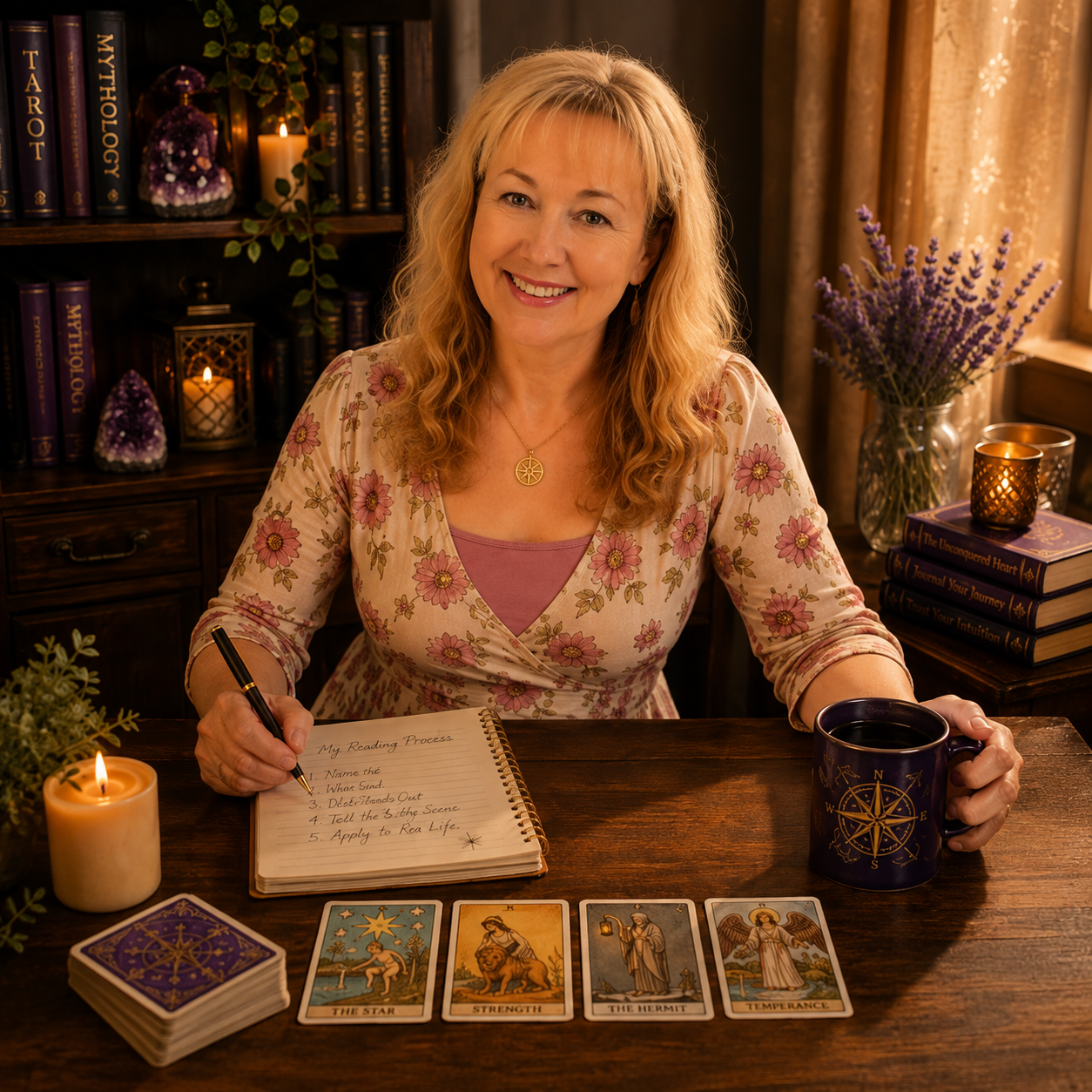
I've been studying and reading Tarot for more than 35 years, and I've spent much of my career exploring how Tarot can be used for insight, personal growth, and meaningful change.
But Tarot is only part of my background.
I also spent years studying psychology and working with people professionally. And the more I learned about both worlds, the more interested I became in what happens when you bring them together.
Tarot has an incredible ability to give people something to respond to.
An image. A symbol. A story. A reaction. A connection they hadn't made before.
Suddenly, instead of sitting across from someone trying to figure out the perfect thing to ask or waiting for them to know exactly what they want to talk about, you have somewhere to begin.
But I didn't want to simply give Tarot readers a collection of therapeutic techniques and tell them to figure out the rest.
Over the years, I developed the Amethyst Tarot Method, the Life Map, and eventually Tarot Therapy itself: a practical, collaborative system for moving from the cards into meaningful conversation, deeper exploration, and intentional change.
I tested what worked. Changed what didn't. Kept studying. Kept teaching. And kept refining the process into something another practitioner could actually learn and use.
That's what became the Tarot Therapy Certification.
It brings together Tarot, conversation, therapeutic practices, professional structure, scope, and ethics into one complete approach to working with clients.
Because knowing what the cards mean matters.
Knowing what to do with what they uncover matters even more.
Tarot Therapy gives people in the helping professions a structured way to meet and support your clients in ways that make a difference in the World.
Frequently Asked Questions
How much Tarot experience do I need?
You should be familiar with Tarot, but you don't need to be an expert or have years of professional reading experience. If you're completely new to Tarot and still need to learn the cards themselves, start with Hello, Tarot! first.
Do I need to memorize all 78 Tarot cards?
No. You'll learn how to interpret cards in context using the imagery, commonly recognized meanings, the question or issue being explored, and what your client notices. You can use reference materials when you need them. The goal isn't memorization. It's knowing how to work with what shows up.
Do I need to be psychic or intuitive?
No. Tarot Therapy doesn't depend on psychic ability. You can absolutely bring intuition into your work if that's part of your practice, but it isn't required to learn or use the Tarot Therapy process.
Do I need professional Tarot reading experience?
No. That's part of what you're here to learn. The Certification guides you from working with the cards through facilitating complete Tarot Therapy sessions with clients. You should, however, already have some familiarity with Tarot before beginning.
How long does the Certification take, and is it self-paced?
The Certification includes approximately 13 hours of recorded instruction across 14 trainings/videos, plus exercises, Life Map work, quizzes, practice sessions, and the final Certification Practicum. The program is self-paced, so your total completion time will depend on how quickly you choose to move through the training and practice. You have one year to complete your Tarot Therapy Certification requirements.
How does the Certification Practicum work?
After completing the required training, you'll submit a final Practicum that brings together what you've learned through Life Map work, a Tarot Therapy practice session, therapeutic-practice application, reflection, scope and ethics, and practitioner self-assessment.
You don't need to demonstrate perfection. You need to demonstrate that you understand the process and can begin applying it thoughtfully and responsibly. Practicum submissions are personally reviewed, typically within about two weeks.
Does this Certification qualify me as a therapist?
No. Tarot Therapy Certification is professional training in the Tarot Therapy method. It is not psychotherapy training, does not confer a mental-health license, and does not authorize you to diagnose or treat mental-health conditions or provide other regulated services outside your existing qualifications.
How long will I have access to the Certification?
You'll receive lifetime access to the Tarot Therapy Certification program.
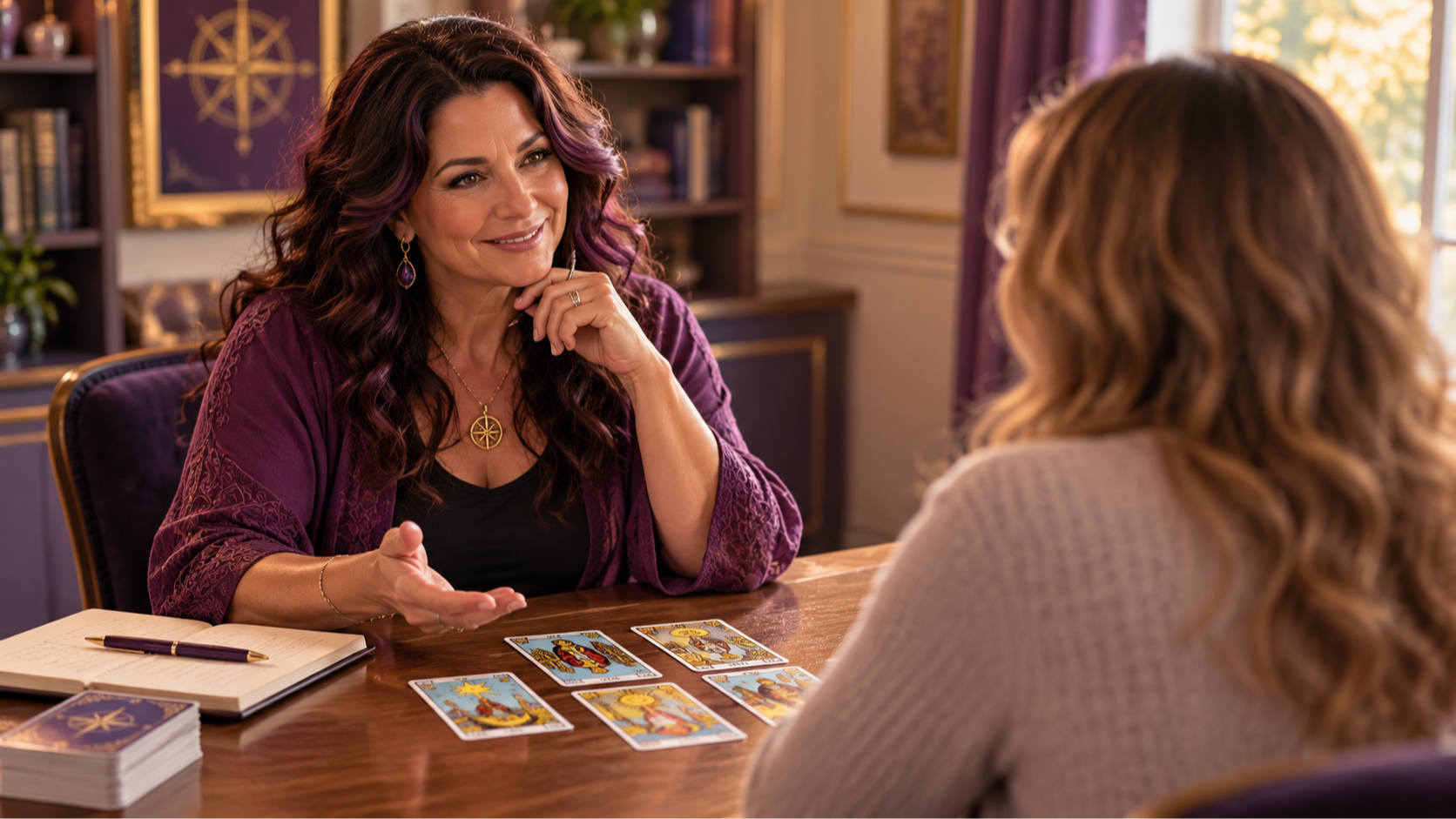
READY TO BECOME A TAROT THERAPY PRACTITIONER?
You don't need to know everything about Tarot before you begin.
You need familiarity with the cards and a willingness to learn how to work with them - and with the person sitting across from you - in a practical, collaborative, professional way.
The Tarot Therapy Certification gives you a complete process for moving beyond simply interpreting cards and into meaningful work with clients.
Learn to interpret the cards in context.
Learn to facilitate the conversation.
Learn what to do with what you discover.
And learn to do it in a way that supports your client's insight, agency, and ability to navigate their own life.
Begin Your Professional Career as a Tarot Therapy PractitionerYour enrollment includes the complete Tarot Therapy Certification training, exercises and practitioner resources, Certification Practicum and personal review, lifetime access to the Certification program, two foundational courses, and your first year of access to the Tarot Therapy Continuing Education Center.