Religious Trauma Doesn't Always End When You Leave
You May Have Left the Religion.
But Did You Leave the Rules?
Religious teachings can continue influencing your relationships, choices, money, body, work, spirituality, and sense of self long after your beliefs have changed.
The Overcoming Religious Trauma Workshop and Books
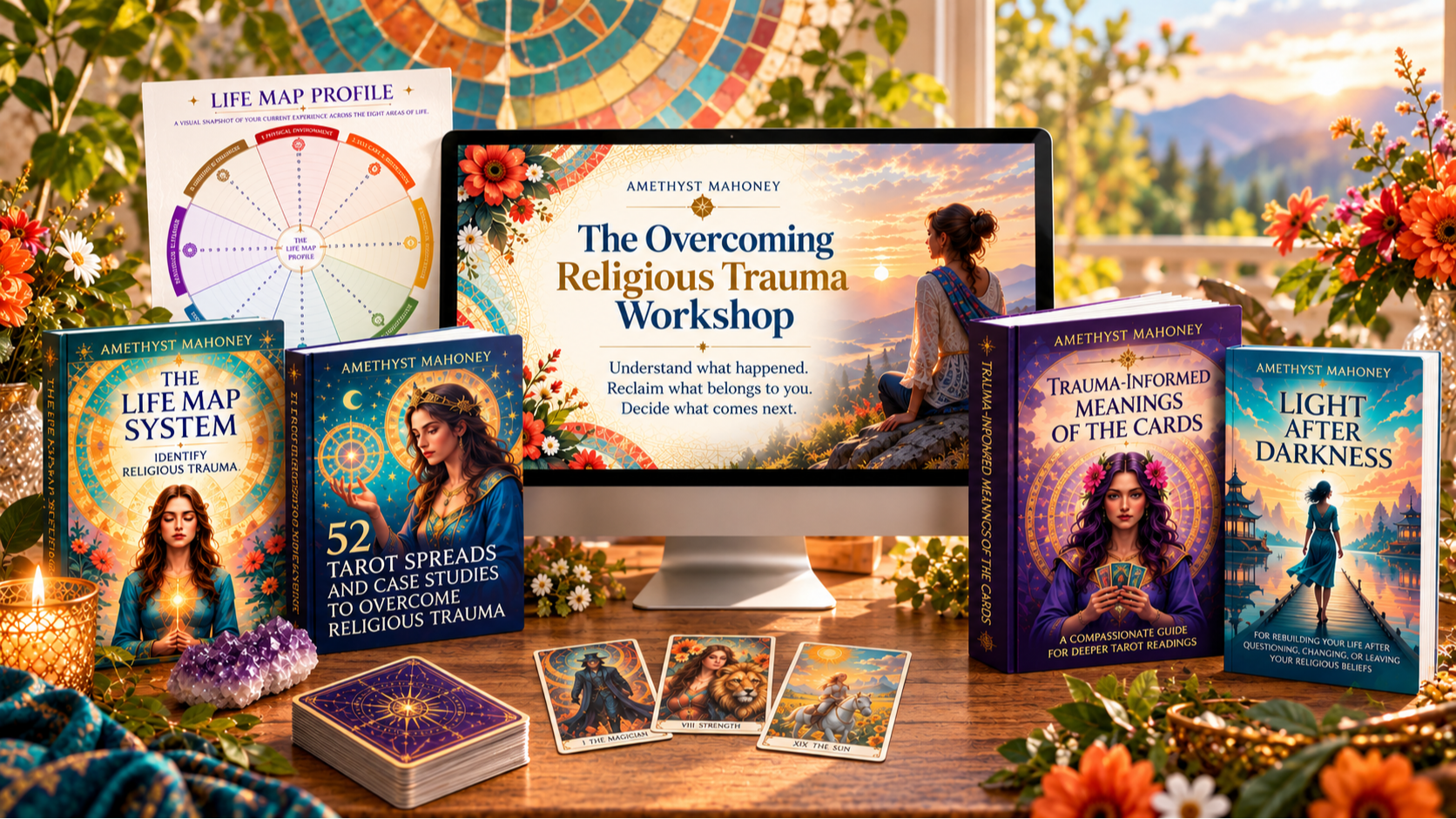
A 70-minute guided workshop and four-book digital collection to help you understand what happened, recognize where religious trauma may still be affecting your life, and decide what belongs to you now.
Explore the Workshop and Books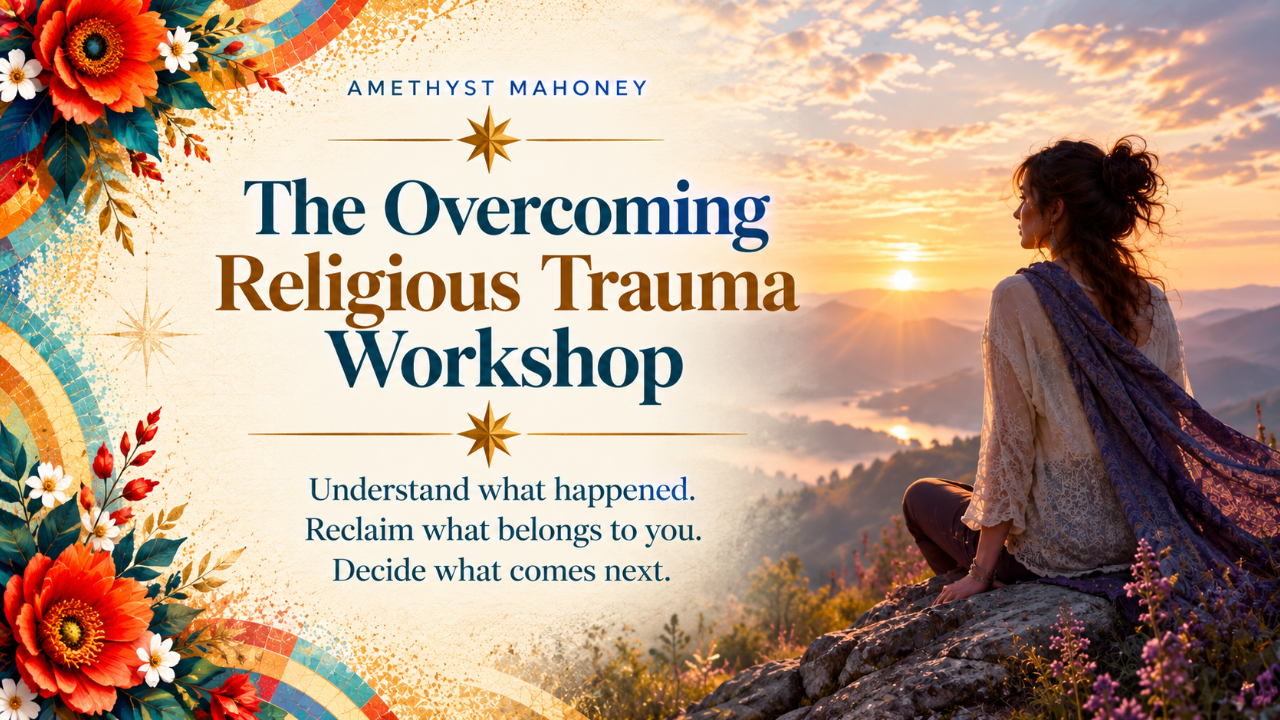
"I Thought I Already Dealt With This."
Maybe you left the church years ago.
Maybe you changed denominations, found another religion, built a spiritual practice that feels more like your own, became atheist or agnostic, or simply stopped believing many of the things you were taught.
You may have done a lot of questioning, learning, healing, and rebuilding along the way.
So why does some of it still seem to follow you?
Maybe you still feel guilty when you say no.
Rest can feel selfish, even when you desperately need it.
You second-guess your own judgment and look to other people for reassurance that you're making the “right” choice. You may still carry shame around your body, sexuality, desires, or relationships.
Wanting money, success, recognition, pleasure, or simply more for yourself can bring up discomfort you can't quite explain.
Setting boundaries with family can feel much harder than it seems like it should.
And maybe, despite everything you believe now, there's still a tiny voice that occasionally whispers:
But what if Hell really is real?
These things can seem completely unrelated.
A boundary problem. A money problem. A confidence problem. A relationship problem. A lingering fear you thought you stopped believing years ago.
But sometimes they're connected by something much older.
Changing what you believe doesn't automatically erase what you learned.
The rules we absorb about what makes us good, worthy, safe, lovable, acceptable - or even allowed to trust ourselves—can continue influencing our choices long after we've consciously rejected the beliefs they came from.
Overcoming religious trauma isn't only about examining what you believe today.
It's also about recognizing the old rules that may still be quietly shaping your life - and deciding whether they still belong to you.
Religious Trauma Doesn't Stay in Your Spiritual Life
When we think about religious trauma, it's easy to think primarily about religion.
What do I believe now? Do I still believe in God? Do I want a spiritual practice? Do I ever want to walk into a church again?
But religious trauma can affect areas of your life that don't seem religious at all.
Something you were taught about obedience might affect the boundaries you set in your relationships.
A message about sacrifice might make it difficult to prioritize your own health or take time for yourself.
Teachings about gender or sexuality may influence how you relate to your body, your partner, or what you believe you're allowed to want.
Ideas about money, humility, service, or your “God-given purpose” can follow you into your career and finances.
And teachings about family, authority, forgiveness, or belonging may continue shaping your relationships long after your beliefs have changed.
That's why the Overcoming Religious Trauma Workshop uses the Life Map to look beyond spirituality and consider your experience across eight interconnected areas of life:
- Physical Environment
- Self-Care & Recreation
- Health & Wellness
- Love & Romance
- Career & Business
- Spiritual & Personal Growth
- Family & Friends
- Finances & Wealth
The Life Map isn't there to tell you that every problem in your life was caused by religion. It gives you a way to look at the bigger picture and notice connections you may not have recognized before.
You may discover that something you've always thought of as a money problem, a boundary problem, a relationship problem, or a problem trusting yourself has roots in an old rule you learned years ago.
Sometimes the belief is gone, but the rule is still running your life.
Once you can see the rule, you can begin deciding whether it's one you actually want to keep.
This Isn't About Telling You What to Believe.
Overcoming religious trauma doesn't require replacing one set of beliefs with another.
You don't have to leave your religion.
You don't have to return to one.
You don't have to choose another one.
You may want to reclaim parts of your religious or spiritual life. You may discover that some things no longer feel right for you. You may find new ways of understanding beliefs or practices that once felt rigid, frightening, or limiting.
You might find meaning in another religious or spiritual path—or decide that religion and spirituality aren't important to you at all.
And you may simply not know yet.
That's allowed.
This work isn't about giving you a new set of answers. It's about creating enough space to examine your experiences, recognize what may still be affecting you, and decide for yourself what you want your life to look like now.
There is no required destination.
The goal isn't replacing one set of rules with another. The goal is getting your choices back.

The Overcoming Religious Trauma Workshop and Books
You don't need to figure all of this out from a single workshop.
Overcoming Religious Trauma gives you a place to begin - and a collection of resources you can return to as your questions and needs change.
1 Guided Workshop
4 Complete Digital Books
1,000+ Pages of Continued Exploration
The workshop provides the map. The books contain the depth.
Begin with the 70-minute workshop, where we'll explore what religious trauma is, how it can continue affecting you long after your beliefs have changed, and how to begin recognizing patterns that may still be showing up throughout your life.
From there, the four included books give you the opportunity to explore specific areas more deeply - from understanding religious trauma across the Life Map to rebuilding after questioning or leaving, using Tarot for continued exploration, and working with trauma-informed Tarot meanings.
But 1,000+ pages doesn't mean you just acquired 1,000+ pages of homework.
You don't have to read every book from beginning to end. You don't have to complete everything in a particular order. And you certainly don't have to work through all of it at once.
Start with the workshop. Then follow the questions that matter to you.
Use the books according to your questions, your experience, and your pace.
They're there when you need them - and you can return to them as your understanding, beliefs, and life continue to change.
What’s Included Inside
The Overcoming Religious Trauma Workshop and Book Series
Inside the 70-Minute Workshop
Religious trauma can be complicated. You may recognize some of its effects immediately while never realizing that other struggles could be connected to experiences or teachings from years ago.
This workshop helps you begin putting those pieces together.
You'll explore:
- What religious trauma is - and what it isn't, including why two people can experience similar religious environments and respond very differently.
- How belief can become a system of control, and how fear, identity, information, relationships, authority, and even positive religious values can be used in harmful ways.
- Why religious trauma can have serious mental-health consequences, and where you can find it as a diagnosis
- How religious trauma intersects with anxiety, depression, PTSD, complex trauma, OCD and scrupulosity, and other forms of serious psychological distress - and why understanding these connections is about taking the effects seriously, not collecting diagnoses.
- Why leaving doesn't necessarily end the psychological impact. Changing churches, changing religions, or no longer believing what you were taught doesn't automatically undo years of fear, shame, self-doubt, or learned patterns.
- How religious trauma can continue showing up throughout everyday life, sometimes in places that don't seem religious at all.
- How the Life Map can help you see the bigger picture, connecting experiences across eight areas of life and helping you notice patterns you may not have recognized before.
- How to begin examining the beliefs and rules you inherited so you can make your own decisions about what belongs in your life now.
- How Tarot can become a tool for exploration rather than another source of authority, giving you new questions and perspectives while leaving the final interpretation - and the choices that follow - with you.
You don't have to understand everything that happened to you in 70 minutes. The workshop gives you a framework for recognizing what may still be affecting you - and a place to begin exploring it.
Get the Overcoming Religious Trauma Workshop and BooksFour Books for Going Deeper
The 70-minute workshop gives you the framework for understanding religious trauma, recognizing patterns, and beginning to see where those experiences may still be affecting your life.
The four included books let you take the next step based on what you want to understand or work with next.
You don't have to read them in order. You don't have to use all four. Think of them as a collection you can return to whenever a particular question, experience, or area of your life needs more attention.
Then I would give each book its own substantial visual block—large mockup on one side, copy on the other. Alternating left/right could look fantastic and would keep this from becoming four giant slabs of text.
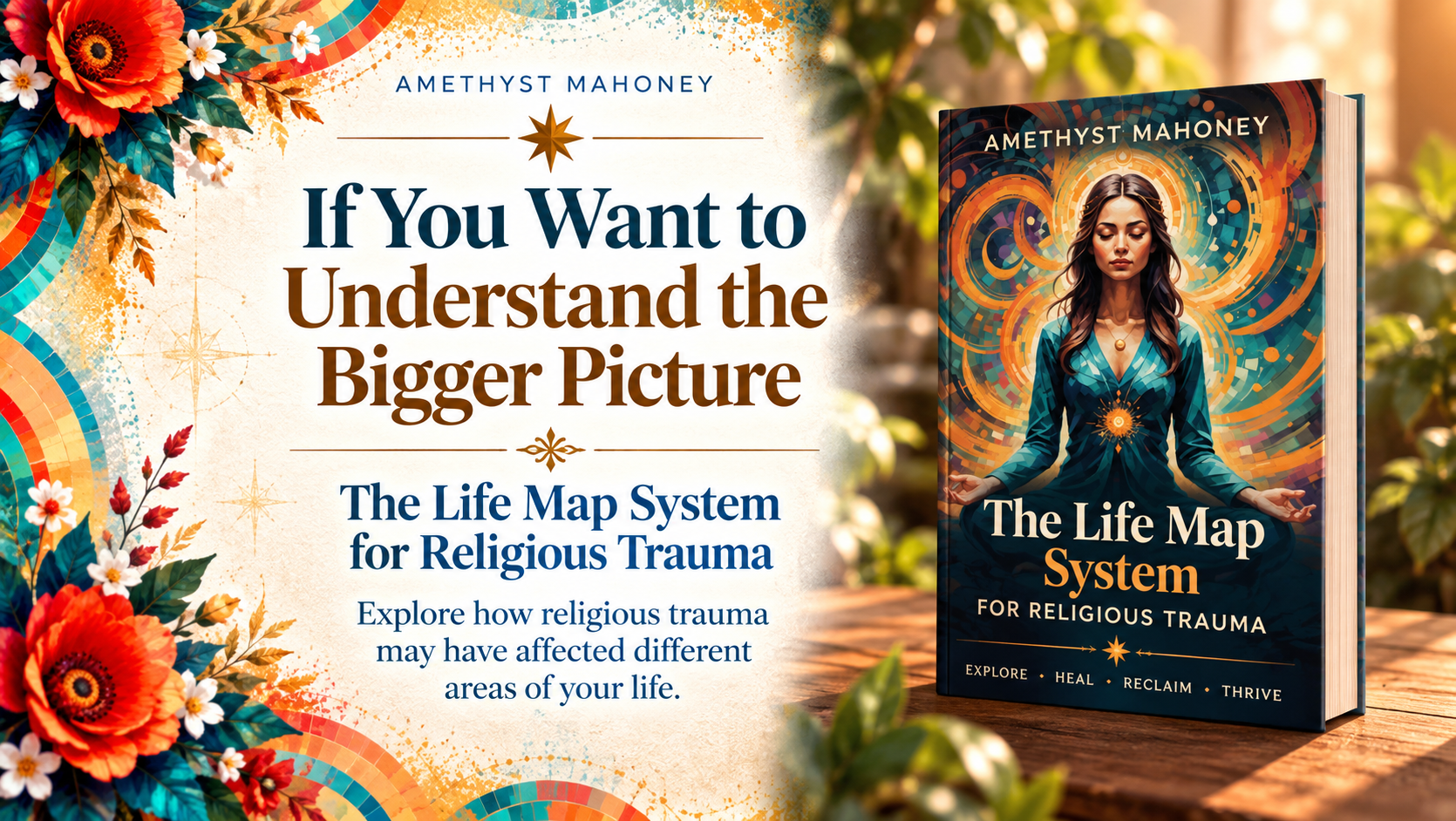
The Life Map System for Religious Trauma
Use this when you want to understand the bigger picture.
Religious trauma rarely affects just one part of a person's life.
The Life Map System for Religious Trauma helps you look across the different areas of your life and recognize how religious teachings, experiences, and expectations may have influenced things that don't initially seem connected to religion.
Use it to investigate patterns, make connections, and better understand how the past may still be showing up in your life today.
Best for: Seeing the whole person and uncovering connections you may have missed.
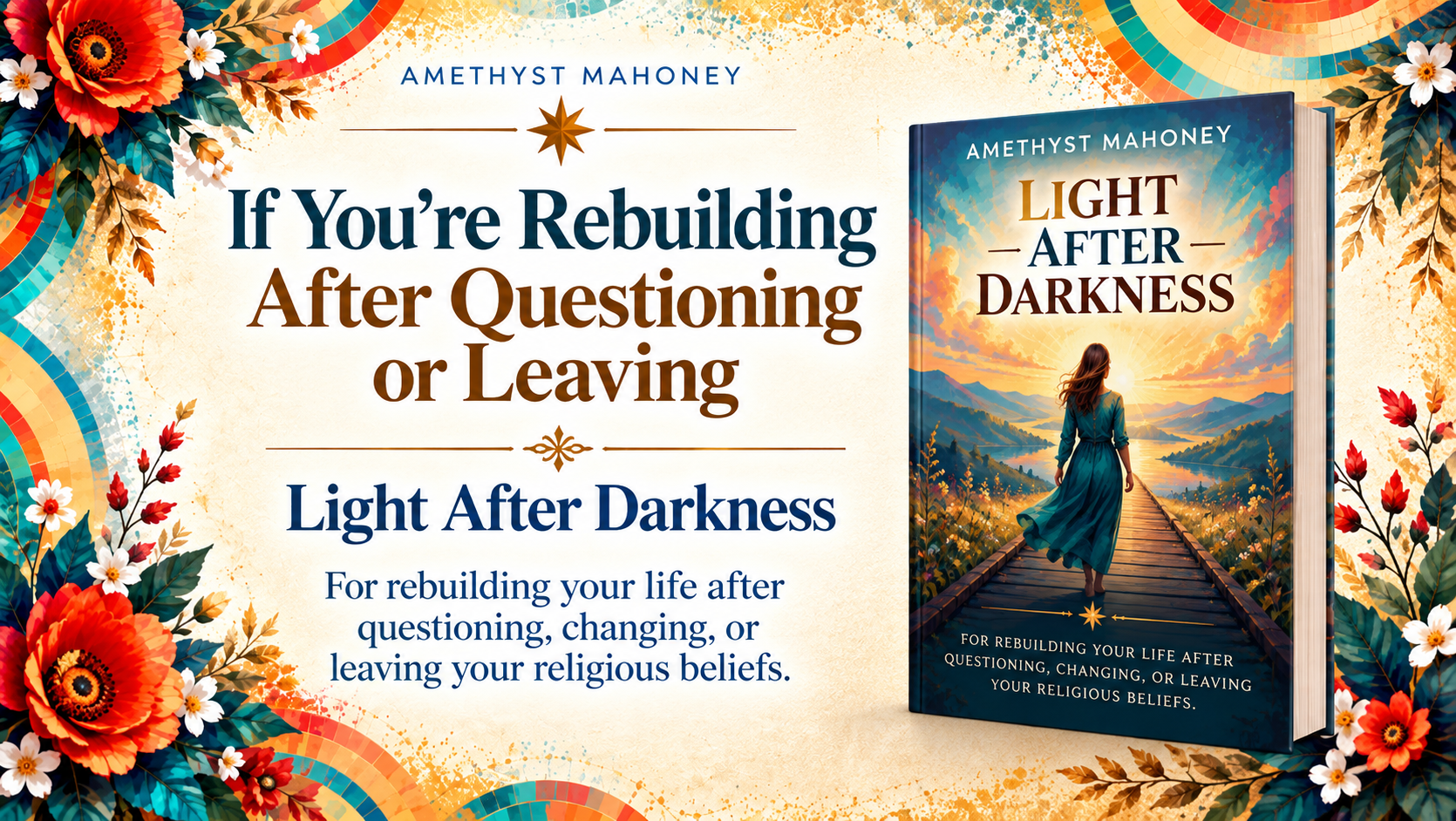
Light After Darkness
Use this when you're figuring out what comes next.
Questioning or leaving a religious belief system can create freedom - but it can also leave behind enormous questions.
What do you believe now? What still matters to you? What parts of your former religious or spiritual life do you miss? What does meaning look like without the certainty you once had?
Light After Darkness is for the process of rebuilding: developing a life, worldview, and relationship with spirituality - or without it - that reflects who you are now.
You don't have to replace one certainty with another.
Best for: Rebuilding after questioning, changing, or leaving religious beliefs.
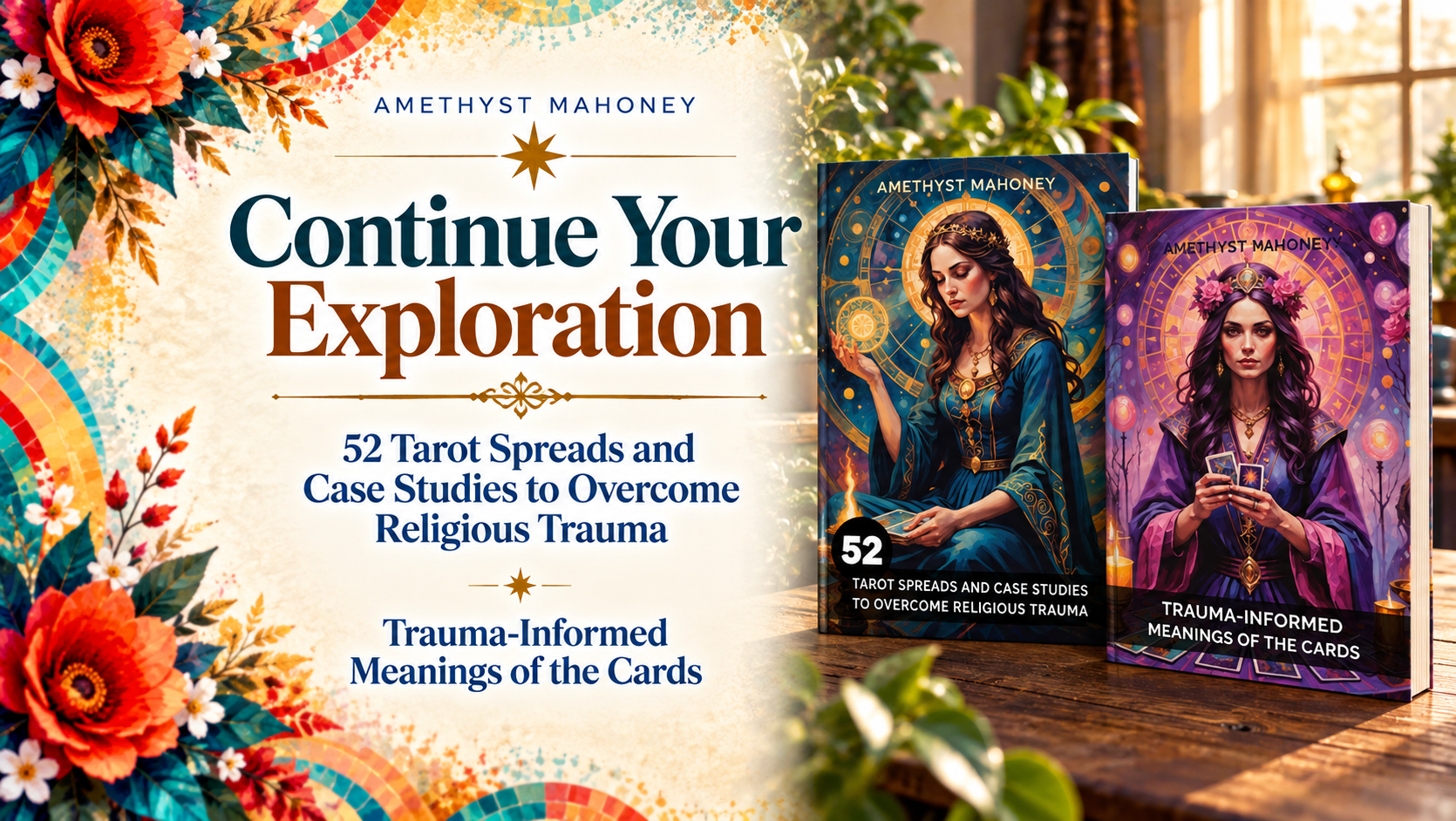
52 Tarot Spreads and Case Studies to Overcome Religious Trauma
Use this when you want guided Tarot work for continued exploration.
Sometimes knowing that something affected you is only the beginning. The next question is: What do I do with that?
This book gives you 52 Tarot spreads designed specifically for continued exploration of religious trauma, along with case studies that show how the questions and cards can be used in context.
You can work through the spreads over time or simply choose the ones that speak to what you're dealing with now.
Best for: Structured Tarot prompts and ongoing personal exploration.
Trauma-Informed Meanings of the Cards
Use this when you want a Tarot reference built specifically for this work.
A Tarot card can look very different when you're examining it through the lens of trauma, religious conditioning, boundaries, identity, relationships, self-trust, or recovery.
Trauma-Informed Meanings of the Cards gives you a dedicated reference for working with the Tarot through those lenses, helping you consider meanings and perspectives that may be especially relevant when exploring religious trauma.
Instead of relying only on general Tarot meanings, you have a resource designed specifically to support the kind of work you're doing here.
Best for: Interpreting Tarot through trauma-informed and religious-trauma perspectives.
Welcome to Your Religious Trauma Reference Library
Four books and more than 1,000 pages might sound like a lot.
That's because it is.
You get all four books so the right one is there when you need it.
This isn't homework. It's a reference library.
You don't need to read everything at once. You don't have to read all four books cover to cover before you can start benefiting from them.
Start with the workshop and notice what stands out.
Maybe you want to understand how religious trauma has affected different areas of your life. Maybe you're questioning what you believe now.
Maybe you're ready to work with a Tarot spread around one specific issue. Or maybe you simply want to look up a card while you're doing your own exploration.
Start with the question you're asking now.
Choose the book, chapter, exercise, or Tarot spread that helps you explore it.
And when the question changes, the rest of your library is still there.
Watch it. Read it. Work with it. Return when you need it.
What Makes This Approach Different?
Religious trauma can affect your beliefs, but it can also affect how you relate to yourself, other people, and the choices you make every day.
This approach brings together the Life Map, personal agency, and Tarot as a tool for exploration to help you understand those connections without telling you what you're supposed to believe - or what you're supposed to do next.
See the Whole Person
Religious trauma doesn't exist separately from the rest of your life.
The Life Map helps you look across eight interconnected areas of life so you can see patterns and connections that might be missed if you focused only on religion or spirituality.
Discover the Sneaky Ways Religious Trauma May Be Showing Up in Your Life
Sometimes the connection is obvious.
Sometimes it isn't.
That problem that keeps showing up in different relationships. The thing you keep doing even though you don't understand why. The guilt that appears whenever you prioritize yourself.
The decision you keep second-guessing. The discomfort around money, success, boundaries, pleasure, rest, or wanting more.
Things that seem completely unrelated can sometimes make much more sense when you look at them in the context of religious trauma.
Something you thought was a relationship problem, a money problem, a career problem, or a problem trusting yourself may have roots in a rule you learned years ago.
Maybe you left the theology fifteen years ago. Meanwhile, “good people put everyone else first” has been hiding under the couch eating your boundaries.
This work helps you look beneath the problem and ask:
What did I learn that might make this make sense?
Not every struggle in your life will trace back to religion. But when one does, recognizing the connection can change how you understand it - and what you decide to do with it.
Make Your Own Decisions
Recognizing where religious trauma may be showing up doesn't mean someone else gets to tell you what those discoveries mean.
The Life Map can help you see connections. The books can give you information and questions to consider. Tarot can offer possibilities and perspectives you may not have considered.
But you decide what fits.
You are allowed to question. You are allowed to disagree. You are allowed to change your mind. And you are allowed to say, “I don't know.”
The goal isn't to replace one rigid authority with another.
The goal is getting your choices back.
This May Be for You If...
There isn't one path through religious trauma.
You may have left your religion years ago. You may still be part of the same religious tradition. You may have found an entirely different spiritual path - or you may still be trying to figure out what you believe.
This workshop and book collection may be helpful if you:
-
Grew up in a fundamentalist, evangelical, high-control, or rigid religious environment and are beginning to recognize how those experiences may have affected you.
-
Left your religion but still recognize old fears, rules, or expectations showing up in your life, even when you no longer believe the things you were taught.
- Are upset with the harmful teachings of fundamentalism, but still miss Jesus
-
Still practice your religion but are questioning harmful teachings, experiences, or expectations and want room to examine them without being told you have to leave your faith.
-
Changed religions or spiritual paths and are sorting through what you want to carry forward, reconsider, or understand differently.
-
Struggle with shame, guilt, boundaries, self-trust, fear, or difficulty prioritizing yourself that may be connected to religious teachings or experiences.
-
Keep encountering patterns that don't quite make sense and wonder whether religious trauma might be one of the missing pieces.
-
Want to discover some of the sneaky ways religious trauma may be showing up in areas of your life you hadn't previously connected to religion.
-
Want to use Tarot as one possible tool for continued exploration without treating the cards as another authority that gets to tell you what to believe or what to do.
You do not need to know exactly what you believe now.
You don't need a label for where you are. You don't need to have decided whether you're staying, leaving, returning, rebuilding, or doing something entirely different.
You can begin with what you know now - and leave room for the rest to change.
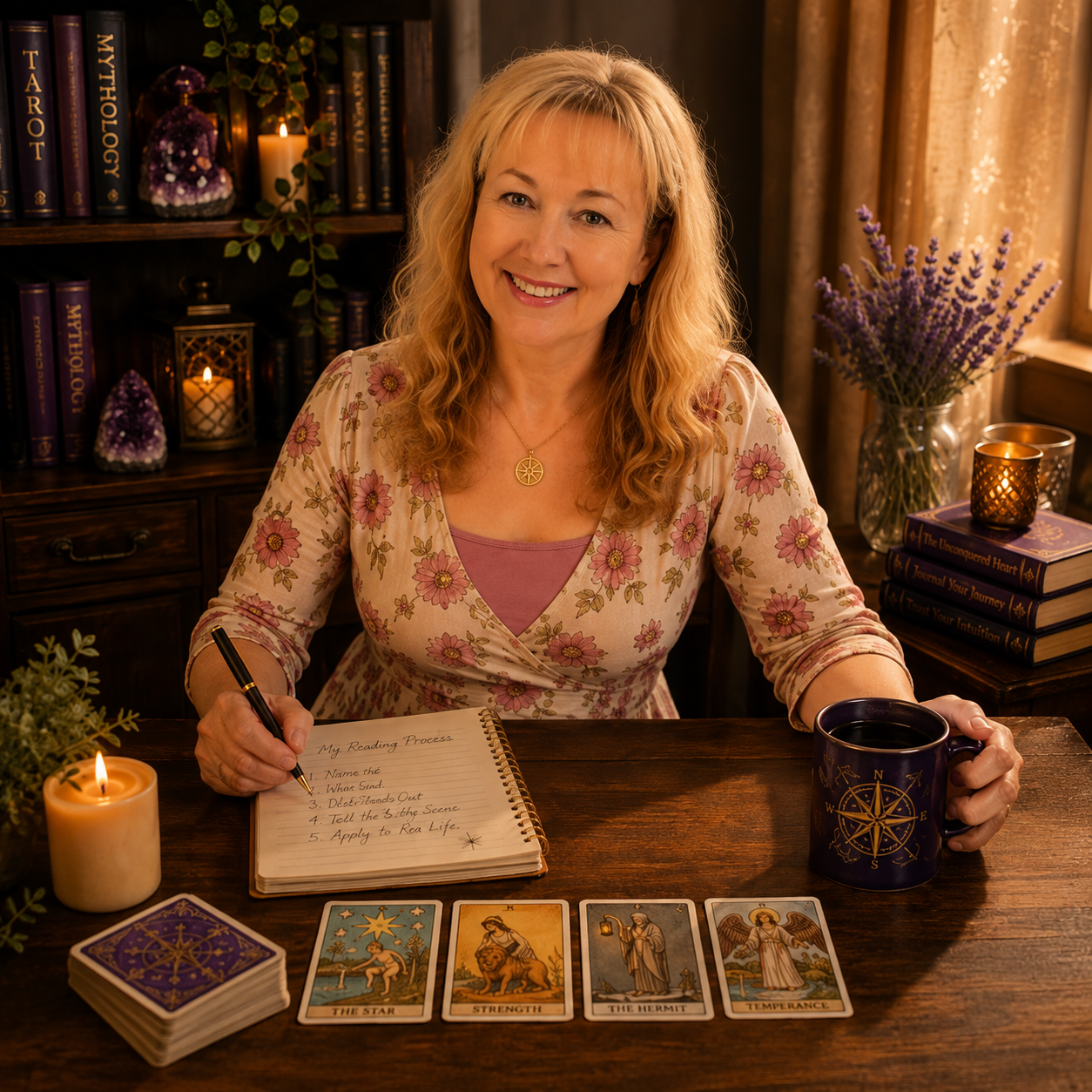
Why I Created This
I'm Amethyst Mahoney. Before my work evolved into Tarot Therapy and the Life Map, I worked as a therapist, and my understanding of religious trauma comes from both professional experience and my own lived experience growing up within fundamentalist Christianity.
But I didn't originally set out to make religious trauma such a significant part of my work.
For years, I worked with clients who were trying to grow businesses. On the surface, their struggles often looked like business problems: difficulty being visible, marketing themselves, charging for their work, setting boundaries, trusting their own decisions, or allowing themselves to become successful.
But increasingly, we discovered that another business strategy wasn't the answer.
Underneath many of those struggles were beliefs about money, humility, service, sacrifice, authority, gender, worthiness, and what a “good” person was supposed to be.
The business problem was almost never a business problem.
That realization helped change the direction of my work.
It contributed to the development of the Life Map, my work with Tarot Therapy, and eventually the Tarot Therapy Certification - all built around a larger question:
What happens when we stop looking at one problem in isolation and start seeing the whole person?
My own experience reinforced that question. Leaving fundamentalist Christianity changed what I believed, but it didn't automatically erase everything I'd learned. Some of those old rules became much easier to recognize only when I could see how they were connected to other parts of my life.
That's why I created this workshop and collection.
To help you discover the connections, understand what may be underneath them, and make your own decisions about what comes next.
Frequently Asked Questions
Do I have to leave my religion to use this?
No. You can examine the ways religion may have harmed you without giving up the parts of your faith that still feel meaningful to you.
This workshop is not designed to convince you to leave your religion - or to return to one.
You may still practice the religion you grew up with, belong to a different tradition now, consider yourself spiritual but not religious, be atheist or agnostic, or have no idea what you believe at the moment.
The goal is to help you examine your experiences and decide for yourself what belongs in your life now.
Is this only for people who experienced Christian religious trauma?
No. Religious trauma can occur within many different religious and spiritual traditions, particularly in environments involving high levels of control, fear, coercion, shame, or rigid expectations.
Many of the examples in the workshop and books draw from Christianity because that is the primary context of my own lived and professional experience. However, the larger concepts and tools can be applied when examining experiences within other religious or spiritual traditions as well.
I've worked with clients who were Christian, Muslim, Buddhist, and even Hindu. Religious trauma is not segregated to one religion.
What if I'm still Christian - or believe in Jesus?
You are welcome here.
Recognizing that you experienced religious trauma does not require you to reject Christianity, stop believing in God, or give up a relationship with Jesus that remains meaningful to you.
You can question harmful teachings without questioning everything. You can recognize that something hurt you while still valuing other parts of your faith.
You can reconsider what you were taught about God, Scripture, church, authority, gender, sexuality, sin, salvation, or any other part of Christianity without knowing where those questions will eventually lead.
For some people, healing from religious trauma includes leaving Christianity. For others, it means reclaiming their faith on their own terms - separating what they genuinely believe and value from the fear, control, shame, or expectations that became attached to it.
And for many people, the answer changes over time.
You don't have to stop loving Jesus in order to examine what happened to you.
Do I need to use Tarot?
Not for all of it, but Tarot is a significant part of this collection.
The workshop and The Life Map System for Religious Trauma provide substantial frameworks for understanding and exploring religious trauma without requiring Tarot. Light After Darkness also provides resources for rebuilding and examining what comes next.
The other two books - 52 Tarot Spreads and Case Studies to Overcome Religious Trauma and Trauma-Informed Meanings of the Cards - are specifically designed for Tarot-based exploration.
If you use Oracle cards rather than Tarot, you can also use them with any of the readings and questions.
You don't need to become a Tarot reader to benefit from this collection, but you should know before purchasing that Tarot is intentionally part of the approach.
Is religious trauma a mental-health diagnosis?
Religious trauma is not currently an official mental-health diagnosis in the United States. However, it is diagnosed as CPTSD in many areas based on the ICD-11 (published by WHO).
Experiences within harmful or high-control religious environments can have real psychological effects, and the workshop discusses how religious trauma intersects with recognized mental-health concerns.
Is this therapy?
No. This workshop and book collection are educational resources for personal learning and self-exploration. They are not therapy, mental-health treatment, diagnosis, or a substitute for individualized care from a qualified mental-health professional.
If working with this material brings up distress that feels difficult to manage on your own, consider seeking support from an appropriately qualified professional.
Do I need to read all four books?
Absolutely not.
Think of them as your religious trauma reference library. You can read them cover to cover if that's your thing, browse the sections that interest you, look up a particular topic, choose a Tarot spread when you want one, or return to different books as new questions arise.
They're yours to use at your own pace.
What format are the books?
All four books are delivered digitally through BookFunnel, and you don't need a BookFunnel account to access them.
You can choose the reading option that works best for you:
- Read directly in your web browser
- Download a PDF or EPUB copy
- Send the book to Kindle, Kobo, NOOK, Google Play Books, or another compatible reading device or app
BookFunnel will walk you through the process of getting your books onto your preferred device, so you can read them wherever and however you like.
How long is the workshop?
The guided workshop is approximately 70 minutes.
You can watch it in one sitting or work through it at your own pace, pausing whenever you want time to reflect or explore something further.
Your Life Belongs to You.
Overcoming religious trauma doesn't require you to have everything figured out. You don't need to know exactly what you believe now, what you want to carry forward, or what might change as you continue to learn and grow.
You can keep what nourishes you and question what doesn't. You can leave something behind, come back to it later, understand it differently, or discover something entirely new.
You can change your mind.
And sometimes, you can simply say, “I don't know.”
There is no single right destination waiting for you at the end of this work. What matters is having the freedom to explore your experiences, understand how they may have shaped you, and decide what belongs in your life now.
You are allowed to choose.
Get the Overcoming Religious Trauma Workshop and Books
Begin with the 70-minute workshop, then use your four-book reference library to go deeper wherever your own questions lead you.
70-Minute Guided Workshop + 4 Complete Digital Books + 1,000+ Pages of Continued Exploration